Death of Katczinsky
The death of Stanislaus Katczinsky is the most devastating personal loss Paul Bäumer suffers in the war, the moment that strips him of his last intimate comrade and leaves him isolated among the remnants of his generation. Kat—forty years old, a cobbler by trade, with a face of the soil, blue eyes, bent shoulders, and a remarkable nose for dirty weather, good food, and soft jobs—has been the group's leader, its cunning provider, and its moral anchor since the opening pages. His death, caused not by a dramatic explosion but by a minute, almost invisible splinter to the head while Paul carries him on his back, epitomizes the war's arbitrary cruelty: a man who survived three years of shellfire, gas, and hand-to-hand fighting is killed by a stray fragment on a quiet errand of mercy, at the very moment Paul believes he has saved him.
The Wounding and the Carrying
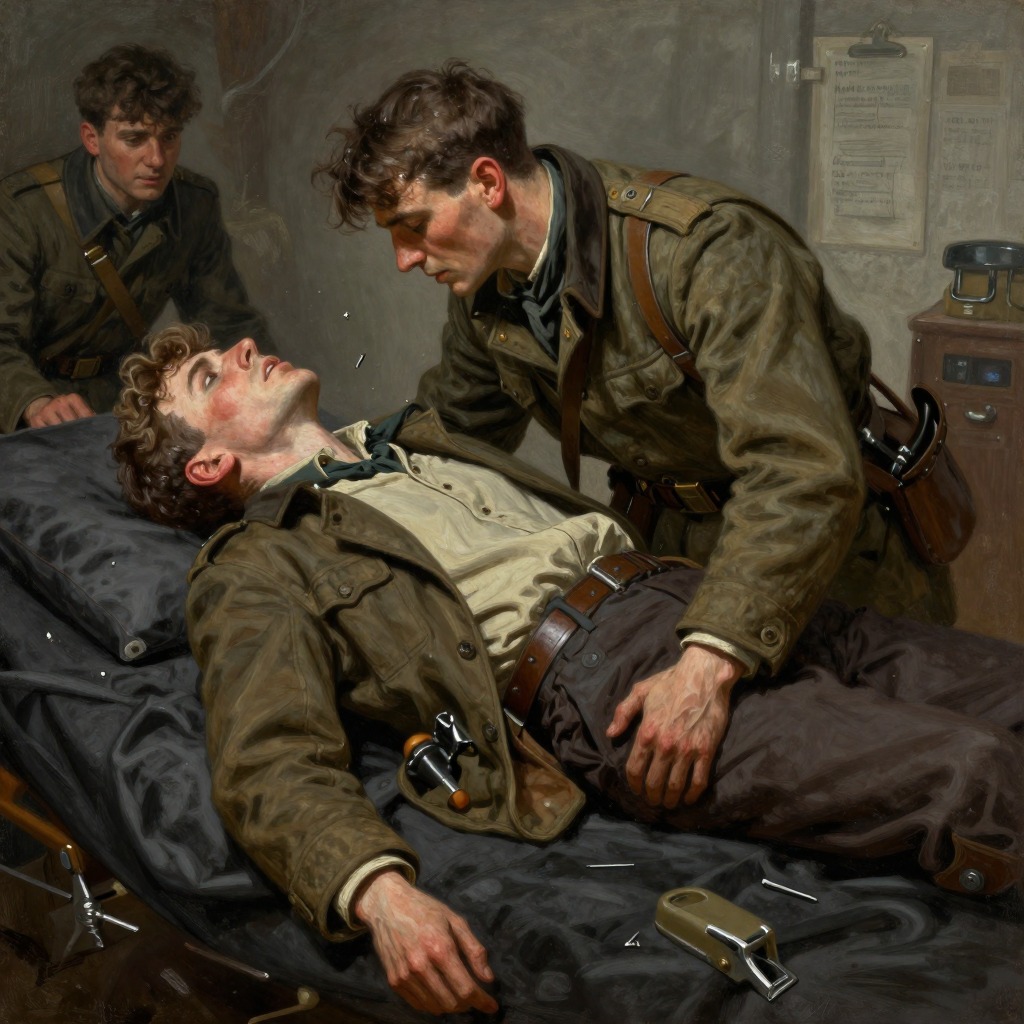
On a late summer day while bringing food up to the line, Kat is hit. Paul binds the wound and sees that Kat's shin is smashed—the bone is broken. Kat groans desperately: "At last—just at the last—" Paul tries to comfort him, saying that now he is saved, that with rest the joint may heal. But the wound begins to bleed fast. Kat cannot be left alone while Paul searches for a stretcher, and Paul knows of no stretcher-bearer's post nearby. Kat is not very heavy, so Paul takes him up on his back and starts off for the dressing station. Twice they rest; Kat suffers acutely on the way. They do not speak much. Paul has opened the collar of his tunic, breathes heavily, sweats, and his face is swollen with the strain of carrying. He urges Kat to go on because the place is dangerous. Paul raises him up; Kat stands on the uninjured leg and supports himself against a tree. Paul takes the wounded leg carefully, then Kat gives a jump and Paul takes the knee of the sound leg also under his arm. The going becomes more difficult. Often a shell whistles across. Paul goes as quickly as he can, for the blood from Kat's wound drips to the ground. They cannot shelter properly from the explosions; before they can take cover the danger is all over. They lie down in a small hole to wait until the shelling is over. Paul gives Kat some tea from his water bottle. They smoke a cigarette.
The Last Conversation
In the hole, Paul speaks gloomily about their coming separation. He reminds Kat of the goose they commandeered together, and of how Kat brought him out of the barrage when Paul was still a young recruit and was wounded for the first time—Paul had cried then, almost three years ago. Kat nods. The anguish of solitude rises up in Paul. When Kat is taken away, he will not have one friend left. Paul says they must see one another again, if it is peacetime before Kat comes back. Kat asks bitterly whether he will be marked fit again with this leg. Paul insists that with rest it will get better, that the joint is quite sound. Kat asks for another cigarette. Paul, very miserable, says they could do something together later on. He writes Kat's address in his pocket book. He feels forlorn already, though Kat still sits beside him, and thinks of shooting himself quickly in the foot so as to be able to go with him. Suddenly Kat gurgles and turns green and yellow, and stammers that they must go on. Paul jumps up, takes him up, and starts off at a run, a slow, steady pace so as not to jolt his leg too much. His throat is parched; everything dances red and black before his eyes. He staggers on doggedly and pitilessly and at last reaches the dressing station. There he drops down on his knees, but has enough strength to fall onto the side where Kat's sound leg is. After a few minutes he straightens up. His legs and hands tremble. He has trouble finding his water bottle to take a pull. His lips tremble as he tries to think. But he smiles—Kat is saved.
The Discovery of Death
Then Paul begins to sort out the confusion of voices that falls on his ears. An orderly says, "You might have spared yourself that." Paul looks at him without comprehending. The orderly points to Kat. "He is stone dead." Paul does not understand. "He has been hit in the shin," he says. The orderly stands still. "That as well." Paul turns round. His eyes are still dulled; the sweat breaks out on him again, runs over his eyelids. He wipes it away and peers at Kat. Kat lies still. "Fainted," Paul says quickly. The orderly whistles softly. "I know better than that. He is dead. I'll lay any money on that." Paul shakes his head: "Not possible. Only ten minutes ago I was talking to him. He has fainted." Kat's hands are warm. Paul passes his hand under Kat's shoulders in order to rub his temples with some tea. He feels his fingers become moist. As he draws them away from behind Kat's head, they are bloody. "You see—" The orderly whistles once more through his teeth. On the way, without Paul having noticed it, Kat has caught a splinter in the head. There is just one little hole; it must have been a very tiny, stray splinter. But it has sufficed. Kat is dead. Slowly Paul gets up. The lance-corporal asks if he would like to take Kat's paybook and his things. Paul nods and receives them. The orderly is mystified: "You are not related, are you?" No, they are not related. Paul raises his eyes, lets them move round, and turns himself with them, one circle, one circle, and stands in the midst. All is as usual. Only the militiaman Stanislaus Katczinsky has died. Then Paul knows nothing more.
Aftermath and Significance
Kat's death is the final severing of Paul's human moorings. Of the seven classmates who volunteered together, Paul is now the last. Kat had been the group's provider—the man who could find food anywhere, who roasted the goose in the night, who brought straw for bedding, who knew the sound of every shell. He was the one who taught Paul how to survive, who carried him out of his first barrage, who sat with him in the graveyard bombardment and passed the gas warning. Their friendship, as Paul reflects during the goose-roasting, was a communion deeper than that of lovers: two minute sparks of life crouching on the edge of death, sharing a quiet fire. With Kat gone, Paul has no one left who shares his full history, no one who remembers the same faces and the same jokes. The death comes in the late summer of 1918, when everyone talks of peace and armistice, when hope is high and the war seems almost over. Kat's last words are "At last—just at the last—" He dies not in a heroic charge or a dramatic bombardment, but from a splinter so small that Paul does not even see it happen. The randomness of the death—a tiny fragment finding the one vulnerable spot—mirrors the chance that has governed all their lives. Paul's reaction, the blank circling of his gaze and the final collapse into unconsciousness, marks the point at which his capacity for grief and connection is exhausted. Two months later, in October 1918, on a day so quiet that the army report says only "All quiet on the Western Front," Paul himself falls.